Several months ago I wrote a post called, "
Is there a link between asthma and air pollution," in which I posed the question to you in a poll: "Does air pollution cause asthma?" I believe it was something like 67% of my readers said they did believe pollution does cause asthma.
I purposely left my question vague because I have noted many people confuse "cause" and trigger." Bellow I will pose a few definitions:
Asthma cause: Anything that turns on the asthma gene causing a person to develop asthma.
Asthma trigger: Anything that results in a person having an asthma attack. There are many asthma triggers, as you can see by this link here.
I think the following stat from
AAAAI.com had many people drawing to the conclusion that pollution caused asthma:
- The prevalence of asthma increased 75% from 1980-1994.3
- Asthma rates in children under the age of five have increased more than 160% from 1980-1994.3
- It is estimated that the number of people with asthma will grow by more than 100 million by 2025.2
- And, not mentioned at AAAAI.com is the statistic that a majority of the 3,384 asthma deaths, and a majority of cases of asthma near death experiences occur in cities, where pollution rates tend to be higher.
All of these statistics had many people leaning toward the notion that pollution causes asthma. Now, while this "theory" still could be true, many statistics and pollution studies done over the past 15 years show that even in cities where pollution rates have declined, asthma rates have continued to increase.
So, is the politically correct notion that pollution causes asthma true? It is possible, as there was a new study released recently that showed that moms who breath in polluted air before their child is born are more likely to give birth to children with asthma.
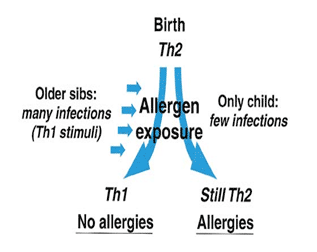
However, more and more scientists have been questioning the notion that pollution causes asthma, and looking at a new theory that says that it isn't so much pollution that turns on the asthma gene, but the fact that we are too clean.
It was in the late 1990s that scientists started looking at asthma statistics world wide that showed impoverished nations where most people lived on farms had the same allergens and pollution levels of U.S. cities, yet had lower rates of asthma
These statistics sent scientists to theorize that perhaps asthma is spreading so fast because modern technology, showers, antibacterial soap, antibiotics and the like are also spreading fast. They came to suspect that asthma is caused because we are to clean.
This was also the conclusion draw after studies showed the following resulted in fewer incidences of asthma:
- Children who are breast fed
- Children who attend day cares
- Children of large families
- Children who do not take antibiotics in first three months of life
- Children who are not born by c-section
In all these cases, children are exposed to bacteria a newborns immune system needs to develop properly.
This theory, now poplar in the scientific community, is called The Hygiene Hypothesis. I wrote a post about this recently, and if you click here I will morph you to my latest asthma post.
Keep in mind here I am not drawing to any conclusions here, just placing all the latest wisdom on the table. When you have are finished you can participate in the poll at the top of my blog. I want to see if your opinion as to what causes asthma has changed.
Thank you, and have a wonderful day.
The Hygiene Hypothesis: Does Cleanliness Cause Asthma? by Rick Frea Wednesday, June 17, 2009 @ HealthCentral.com
Asthma-like symptoms were recorded in the earliest forms of writings going all the way back 5,000 years. With all that history, it's hard to believe we only recently started coming up with viable "guesses" as to why some people develop asthma. My favorite guess is the hygiene hypothesis.
The ancient Romans found a link between cleanliness and disease, and created aquaducts to supply clean water and bath houses to give people a place to wash up. When bacteria were discovered in the 1800s, the Roman's were proven correct.
Since the discovery and understanding of how germs cause disease, there has been an effort by society to stay clean. But is it possible that we have become so clean that we have opened ourselves up to suffering new kinds of diseases? Is it possible that civilization causes asthma? According to the Hygiene Hypothesis, the answer is yes.
Many scientists speculated that the same things that trigger acute asthma attacks are the same things that cause asthma. In that sense, many scientists looked at pollution as a main cause. Asthma rates increased by 75% between 1980 and 1995. Most asthma deaths (80.2% according 1989 stats) occured in highly populated urban areas as well.
However, while pollution has been proven to "trigger" asthma, other studies show that in areas where pollution levels are decreasing asthma rates are still on the rise.
This research encouraged David P. Strachan to look in a unique direction. He made an observation that in Third World nations where people lived in poverty, on farms, and were rarely innoculated from infectious disease, asthma rates were lower than in developed nations like the U.S., Europe and Australia with high concentrations of the population living in urban areas and high rates of childhood vaccination.
He also observed that the same pollution and allergens that exist where asthma rates are low also exist in places where asthma rates are high.
He then proposed the Hygiene Hypothesis in the British Medical Journal in 1989. This hypothesis, or educated guess, is that the asthma gene is not turned on because we are too dirty, but because we are too clean. He came to this conclusion after looking at studies that revealed people who live near farm animals were less likely to develop asthma. Since people in many Third World nations work in farming or are often around animals, they are exposed to bacteria and parasites common around these animals.
Likewise, studies revealed people exposed to pig and cattle parasites and bacteria in the first three months of life (when their immune system is still developing) were less likely to get asthma. According to The Medical College Of Wisconsin, these studies and observations "led several researchers to conclude that organisms in cattle dust and manure may be the stimuli that their immune systems needed to fight off asthma."
Also, several studies (like this one) showed that children exposed to pet dander (proteins in pet saliva and skin, but not pet hair) were less likely to develop asthma. This seems counterintuitive, since it is common (and correect) advice for people and children with asthma and allergies to either get rid of their pets or to, at least, keep them out of the bedroom and off the furniture.
So why would this be? Consider this: asthma is an autoimmune disease. When we are born, our immune systems are still developing. Considering that our immune system doesn't fully mature until we are about 3 months old, it is prior to this time that something "might" occur to turn the so-called asthma gene on -- if a person has the asthma gene.
The hygiene hypothesis surmises that if we are not exposed to certain bacteria and parasites for our immune systems to battle, our immune systems get "bored" and may, instead, react to and create antibodies against normally harmless substances such as pollen and dust, i.e. allergens.
Once the asthma gene is turned on, you, more than likely, will have asthma. Many people will notice asthma symptoms in childhood as they are exposed to their asthma triggers. However, many others will have symptoms so mild during childhood they won't even realize they have it until they are adults (adult onset asthma).
Per this hypothesis, there are people that may be at higher risk of developing asthma as well as events more likely to trigger its development, such as:
However awkward this sounds, it all makes sense to me. What do you think?

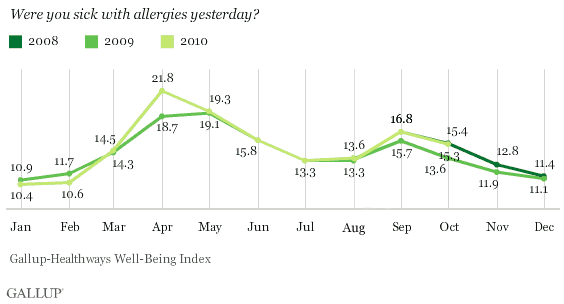 As reported here in the Los Angeles Times, Gallup released a poll "while you were sleeping" that showed that 85% of Americans were not sick yesterday with allergies. What might make this poll most interesting is "perhaps, because it has nothing to do with politics."