Tuesday, November 30, 2010

Study shows coaches need more asthma ed

In a recent blog entry over at About.com by Pat Bass, "Coaches not prepared to help students with asthma," he mentions a recent study presented at the meeting of the American College of Chest Physicians that shows that child coaches are not prepared to care for kids having an asthma attack.

According to the study:
  • 35% of coaches felt they had adequate training to be prepared for an asthma emergency.
  • Half of coaches could not recall any asthma symptoms of asthma
  • 25% could name only one asthma symptom
  • Less than half of coaches said they were notified of a student self-medicating asthma symptoms
  • More than 70% said they had no available medical assistance during practice or games.
There is really no surprise here. Yet I think they should take this study and compare it with similar ones performed 30 years ago and see if there is any improvement. Despite these results, are coaches more asthma wise than 30 years ago? That's what I'd like to know.

Sunday, November 28, 2010

Science in reverse

When I was in RT school we discussed one day the ethics of how it is decided that a certain medicine or procedure becomes the treatment of choice, or one of the recommended options, for a particular patient diagnosis.

For example, based on the latest wisdom, based on best practice evidence, physicians that offer recommendations to the Centers for Medicaid and Medicare Services (CMS) have decided that a bronchodilator breathing treatment is beneficial for most pneumonia patients, and therefore this is one of the treatment options they look at when determining if the patient meets Intensity of Service in determining if or how much the hospital should be reimbursed for that patient.

A breathing treatment with Albuterol was included as a means of proving Intensity of Service because a study was completed a while back that showed the Beta Adrenergics, along with dilating bronchioles, also increase sputum secretion. Therefore, it is believed it will help the patient cough up the sputum.

Based on this wisdom, breathing treatments are now ordered on all pneumonia patients at Shoreline Medical. Yet there is no evidence that beta adrenergics like Albuterol do any good for pneumonia patients. There have never been studies in this regard. Therefore, someone came up with the theory that bronchodilators benefit pneumonia patients, and now all pneumonia patients get them.

The theory is that modern bronchodilators are safe, so why not just give them. Well, the reason why not is a cost measure. If you are giving a bronchodilator to a patient who technically doesn't need them, then you're wasting your money. Yet, to make sure the hospital meets Intensity of Service, it's wise to include Beta Adrenergics in the order set for pneumonia. Yes, this results in overkill, and loss of money for the hospital, yet in the long run it benefits the hospital because it assures reimbursement. Or at least it assures the hospital won't have to participate in a costly battle with CMS over payment for that particular patient.

So usually in the medical field we do science in reverse. Someone comes up with an idea, and we do it on everyone. Then we do it until it's proven not to do any good. Kind of like we did IPPB until it was finally decided all it did was overinflate good alveoli. We did that goofy thing for over 30 years until it was proven to be not necessary to improving outcomes. (although we do have one doc who still orders it from time to time).

We give bronchodilators on patients with congested heart failure, pneumonia, pneumothorax, pleural effusions, and even pulmonary embolisms (PE). There is actually science to prove that PEs do cause some localized bronchospasm, yet no evidence I've ever seen that shows conclusively that a beta adrenergic will even reach this localized region.

So I imagine doctors and RTs and nurses will continue to recommend continuous nebs on certain patients until -- perhaps in another 30 years -- more evidence comes along to show they don't do any good past an hour. That, perhaps, after three nebulized Albuterol treatments all the beta adrenergic receptor sites on the bronchioles are saturated.

Or, perhaps a study will come out showing that as soon as the steroids start working, and parts of the lungs open up, perhaps due to a patient coughing up a mucus plug, those beta adrenergics will be right there waiting to take up the spot and cause more bronchodilation.

So I suppose continuous nebs will be ordered on some patients for years to come. Or unless the patient refuses I suppose. Yet since most patient s who get treatment in the emergency room are in no condition to refuse, that job is left up to the physician.

And since most patients don't pay out of their pockets, they really have no incentive to refuse therapy.

Real science would have it that many studies be done to prove a certain therapy really benefits the patient. Then it's recommended based on best practice medicine. Yet in the real world, physicians don't want to wait 30 years. So, if the experts believe it might help, and it's deemed safe, they just do it.

So that's why we do chest physiotherapy as part of the pulmonary toilet. In theory the vibrations caused by clapping your hands on the chest help knock out secretions, yet in reality the evidence is mixed. Yet we still do CPT. What can it hurt? So the theory goes.

Yes, best practice evidence shows CPT benefits some patients. It may even be 2%. It may be 10%. Yet how do you know what 10% it will help? You don't. Therefore, you order it on every patient with a given diagnosis, or with a given lung sound, or whatever.

I think that order sets are great, as I wrote here. Yet I also believe since most of what we do is based on reverse science, this also results in overkill -- too many meds and too many procedures being ordered -- just to cover your bases results in loss of dollars for the hospital. Although CMS is assured to need to pay less, so the government will pay less.

And the fact that CMS gets to pay less is the bottom line.

So because we use science in reverse and order sets to help the patient meet Intensity of Service, this results in overkill. This ultimately results in increased cost to the hospital, decreased cost for the government, and a lot more work for RTs and RNs. This can lead to burnout and apathy.

Ideally, instead of doing the same things on every patient with a given diagnosis, some hospitals are going to protocols that allow RTs and RNs to do what works and not do what doesn't work. Some hospitals are ahead of the game in this regard. Yet some are still lagging behind. It's not easy getting a doctor champion.

Still, even with protocols, Intensity of Service still must be met. And in the world of HMOs and CMS, there will continue to be overkill, and procedures will continue to be ordered based on reverse science.

Saturday, November 27, 2010

My social gaff

So I'm attending administrative meetings now from time to time. If only they knew of my ulterior motive of ending bronchodilator abuse by insidious means they might not allow this. But my secret is safe here with you.

It's kinda neat, cause I get to dress important. You know, suit, tie and all that jazz. I don't think I'm any different with that stuff on, but someone told me I gotta look good.

So, today was my third meeting, and, considering I don't wear a watch, I'm thinking I'm running late. So when I got to the board room (yes, we get to meet in THE board room, leather chairs and all), the double wooden doors are shut.

Well, your humble RT didn't think anything of it, and he just charged right nt, smoothly (or schmoodly as I like to say). I didn't recognize any of the 16 people in the room as they were chatting discordantly, yet I proceeded to take up one of the chairs around the table.

It had never occurred to me even then that this was a meeting that had run over. No one looked at me awkward or anything like that. And I just sat there and leaned back in my chair like I belonged. It was kinda cool actually.

Then some big wig said, "Well, meeting adjourned." That was when I realized I made a boo boo by entering this room. Yet I just stayed put, leaning back in my chair, one leg crossed over the other in my usual equanimitous manner.

As these folks shuffled out, folks I recognized shuffled in. So I got up out of my comfortable position and grabbed some grub. You know, any meeting with important people (like docs) has food, which is one of the perk to meetings like this.

gaff!!

Friday, November 26, 2010

Nature better pick-me-up than coffee???

I've been working night shift since 1991, and I worked as the lone night shift RT here at shoreline since November of 1997, and during that time I imagine I had, say, maybe five cups of coffee. Yet since becoming a day shifter in January of this year I've become a regular coffee drinker.

There's a couple reasons I never drank coffee, the main one being that I hated the taste of it and I never noticed any "pick me up" from it. I never needed a mental acuity boost, and I never needed to drink a cup of coffee to feel alive, because until about 2006 I was chronically dependent on theophylline -- a xanthine with the same effects as coffee.

Yet after being weaned from theophylline, I suppose my body needed some form of an acuity pick me up for me to feel alive in the morning, and when I observed coffee was available to anyone working day shift, I tried a cup. And, lo and behold, it made me feel more alive. Thus, I've become addicted to the nasty tasting stuff in a short period of time.

I drink it black with sugar -- lots of sugar, to deaden that nasty taste. I tried the flavored kind, and I hate that even worse than the bland coffee taste itself. Thus, black, with sugar, it is.

In essence, coffee has replaced theophylline in my life.

Yet this morning I found myself reading one of my wife's magazine, Healthcare Traveler, July, 2010 edition, and I came across, on page 8, a study that was originally published in the Journal of Environmental Psychology. Keep in mind the only reason this magazine floats around my home is because my wife is a nurse and gets it for free.

The article notes that "being outside in nature makes people feel more alive," which is why a study was done to compare the effects of being outdoors in nature as compared to having a cup of coffee in the morning.

Researchers say we feel depleted, we need to be revived, and we reach for a cup of coffee in the morning. Yet, researchers, by reviewing the results of this study, now know what common sense may have already known, that allowing your body to breathe in the outdoors, among the fresh breeze, to smell the fresh greens, and absorb the sun's rays, may have the same pick-me-up, reviving effect, as a cup of coffee.

This study, or one similar to it, was also mentioned and discussed by Anahad O'Connor, health blogger for the newyorktimes.com, in "The Claim: Exposure to Plants and Parks Can Boost Immunity."

Actually, he notes a scientific reason for this: "
Stress reduction is one factor. But scientists also chalk it up to phytoncides, the airborne chemicals that plants emit to protect them from rotting and insects and which also seem to benefit humans."

Likewise, O'Connor notes (link provided by O'Connor), "The scientists found that being among plants produced 'lower concentrations of cortisol, lower pulse rate, and lower blood pressure,' among other things."

He ads, "
A number of other studies have shown that visiting parks and forests seems to raise levels of white blood cells, including one in 2007 in which men who took two-hour walks in a forest over two days had a 50-percent spike in levels of natural killer cells. And another found an increase in white blood cells that lasted a week in women exposed to phytoncides in forest air."

I just thought this was interesting to note. A few years ago I read a Time magazine article about the effects of coffee. It basically reported that there have been millions of tests done on coffee over the years, and most note coffee to be safe. And most do note that coffee does provide a sense of vitalization after a cup or two.

Yet, research also shows that once your body gets used to one cup of coffee, you actually need to drink one cup of coffee just to get back to your normal vitalized state. And to get the pick-me-up feeling you actually have to have a second cup of coffee. In this way, your body becomes tolerant to coffee, and addicted at the same time.

So, stuck inside for 12 hour long shifts, I can see how many people have become dependent on coffee, at least since it has become a main staple in the United States since the industrial age as more and more Americans started working indoors.

Drink up!


Thursday, November 25, 2010

Happy Thanksgiving 2010

Happy Thanksgiving to all my valued readers. I could not do this without you. Thank you very much. 13 Things We Asthmatics Can Be Thankful For
by Rick Frea Tuesday, November 24, 2009 at Myasthmacentral.com

You and I have come to grips with the fact we have a disease called asthma. Sure it's caused us some hardships along the way, and for some of us lots of hardships, yet in the end we asthmatics have a lot to be thankful for this Thanksgiving holiday.

1. Asthma wisdom: In the 2,000 years since asthma was first described, this wisdom has come a long way. Scientists have yet to find a cure, but they have taken giant strides in that direction in recent years, beginning with the discovery of the asthma genes. And while there is no cure yet, doctors and asthmatics are now equipped with some great asthma wisdom to help us asthmatics lead a normal, active life.

2. Asthma medicine: I read a book called "
Mornings on Horseback" which was about Teddy Roosevelt's struggles with asthma when he was a kid. When he lost his breath there were few options to help him find it short of a ride in horse and buggy in the cool night air (and that buggy probably kicked up a load of dust mites for him to inhale too). We modern asthmatics can be thankful for Ventolin, Xopenex, Advair, Symbicort, Singulair and all the modern medicines available to treat our symptoms and, in some cases, prevent them altogether. We should also be thankful these meds are relatively safe too.

3. MyAsthmaCentral: Sincerely and honestly, sites like this are the greatest things to come the way of the asthmatic. When we were growing up, many of us thought we were alone. When new wisdom arrived we had no way to learn about it short of an expensive and hard to read book that came out once every several years. Now, not only do we have our community, we literally have access to all the greatest and latest wisdom at our fingertips.

5. Asthma books: I don't know if it's just me, but it seems modern asthma books are not only relatively inexpensive but they make asthma a simple disease. One such example is "
Asthma for Dummies." Asthma is a very complicated disease, and this book makes it easy to understand. Every asthmatic should have an asthma book at his or her bedside for reference, and for the fact we now have access to many easy to read books on asthma is something we should be thankful for.

6. Science: We ought to be thankful for all the wisdom that is so complex most of us have a hard time even fathoming it. All those test tubes, the formulas, the discovery of mast cells, T-cells, cytokines, DNA, RNA, and all the other pieces that make it possible to prevent and treat this disease, and some day come up with a cure. For this we are thankful.

7. Scientists: Let us not forget all the great people who are working so hard to make it easier for all of us to breath.

8.
Gallant Doctors: Let us not forget the other half of the patient-doctor team. These doctors work hard all year long to keep up on their asthma wisdom so they are better equipped to take care of us, and for that we are greatly thankful.

9. The doctor educators: There are institutions that house the scientists and do all the research (such as
National Jewish Health) and make sure regional asthma doctors are educated on the latest asthma wisdom. In the past communication here was poor, and now it should get an A+ grade. For this we are thankful.

10. It's preventable: Thanks to those scientists listed above doctors now know most asthmatics have some degree of chronic inflammation in their air passages that is treatable with medicines like Advair and Symbicort. Thanks to this preventable medicine asthma episodes should be far and few between, if they show up at all.

11. Pharmaceuticals: Some people complain they gouge us out of too much money for their product, but we should be thankful that they have taken the financial risk to search for, invent, and manufacture the medicines that allow us to lead relatively normal lives. Thank you.

12. Pharmacists: Let us not forget these fine folks for whipping up our prescriptions and serving them with a smile. We should also be thankful for the wisdom they provide about our medicines.

13. It's treatable: Teddy Roosevelt didn't have access to a medicine that gave him relief from his asthma until 1903 when epinephrine was discovered. Today we have medicines like Ventolin and Xopenex that can help us catch our breath real quick. For this we are definitely thankful.

When you think about it, we asthmatics are pretty fortunate to be alive in an era of great asthma wisdom and wonderful asthma medicines, and for this we should be especially grateful.

Thank you, fellow asthmatics, for taking the time to hang out with us. Have a wonderful Thanksgiving

Wednesday, November 24, 2010

Hospital Quality Assurance Analyzer

One of the newer jobs in the hospital setting is the hospital is quality assurance analysis, and the position of quality assurance analyzer or manager. Basically speaking, this is a person who is responsible for making sure the hospital is doing what is needed to improve outcomes of patients and to reduce costs.

The best definition I found on the Internet was at Hospital Quality Assurance Services, which describes a historical view of the hospital as whatever the doctor wanted to do he or she did, and whatever he ordered was completed by the medical staff, be it the nurse, respiratory therapist, x-ray tech, or lab tech. The doctors pretty much had the run of the mill per se.

Yet then came the day of the HMO and the Medicare, where third party insurance companies and the government were paying the majority of the bills.

Basically, it goes something like this:

" Traditionally, doctors have always enjoyed a great deal of freedom in their practices. Till some time back, the techniques for monitoring and assessing the quality of care they provided in the hospital were based on internal peer reviews. But with the growth of consumer awareness movements, public concern of health care priorities, governmental concerns about rocketing healthcare costs, new hospital accreditation guidelines and financial constraints of health institutions, hospital quality assurance has become compulsory for hospitals to project the quality of care, they provide."
So it's the role of the quality assurance analyzer to make sure of the following (the following information obtained from http://www.careerplanner.com/ and virginia.gov/careerguides/hospitalQAanalyzer):
  1. Monitor data obtained from CMS Core Measures and record the data for review by both the CMS and the hospital's monthly Keystone Committee.

  2. To come up with ideas for improving performance on core values to improve patient outcomes and reduce costs.

  3. To consider relative costs and benefits of potential actions to choose the most appropriate one.

  4. Understanding written sentences and paragraphs in work related documents.

  5. Giving full attention to what other people are saying, taking time to understand the points being made, asking questions as appropriate, and not interrupting at inappropriate times.

  6. Talking to others to convey information effectively.

  7. Communicating effectively in writing as appropriate for the needs of the audience.

  8. Using logic and reasoning to identify the strengths and weaknesses of alternative solutions, conclusions or approaches to problems.

  9. Using mathematics to solve problems.

  10. Identifying measures or indicators of system performance and the actions needed to improve or correct performance, relative to the goals of the system.

  11. Identifying complex problems and reviewing related information to develop and evaluate options and implement solutions.

  12. Using scientific rules and methods to solve problems.

  13. Interprets and implements quality assurance standards in hospital to ensure quality care to patients

  14. Reviews quality assurance standards

  15. Studies existing hospital policies and procedures

  16. Interviews hospital personnel and patients to evaluate effectiveness of quality assurance program.

  17. Writes quality assurance policies and procedures.

  18. Reviews and evaluates patients' medical records, applying quality assurance criteria.

  19. Selects specific topics for review, such as problem procedures, drugs, high volume cases, high risk cases, or other factors.

  20. Compiles statistical data and writes narrative reports summarizing quality assurance findings.

  21. May review patient records, applying utilization review criteria, to determine need for admission and continued stay in hospital.

  22. May oversee personnel engaged in quality assurance review of medical records.

They work with doctors, administrators, and other staffers at the hospital by organizing data, such as core measures, and to use that data in such a way as to improve performance at the hospital, and to reduce costs.

When by reviewing data they observe a problem, they notify the appropriate officials or department heads, who get to the bottom of the problem and then try to rectify it.

For example, it's the job of the Utilization Review Manager to double check charting to make sure charting is complete, protocols and order sets are complete, and that everything is complete in order to meet Intensity of Service (the patient was sick enough to be admitted) and Core Measures (every thing that needed to be ordered based on the most up-to-date wisdom was ordered for that patient).

If a problem is encountered that, it must be determined if this was an isolated problem, or if it is a problem that goes deeper.

For instance, when the core values were first monitored in 2007 at Shoreline Medical, smoking cessation orders were missed 70% of the time. This data was reported by the Quality Assurance Analyzer, and later brought up at a monthly Keystone meeting, where a plan was set in place to improve in this area.

Now smoking cessations are completed and charted accurately nearly 100% of the time.

Another problem back in 2007 was it was discovered via studies that pneumonia patients who received a flu vaccine and pneumococcal vaccine were less likely to get secondary pneumonia and return to the hospital. This this was made into a core measure.

Back in 2007 only 70% of patients received these vaccines. In 2010 nearly 100% of pneumonia patients receive these vaccines.

So you can see, it's the job of the quality assurance analyzer to analyze this data and to come up with idea, and to work with others in the hospital, to solve problems. The entire purpose of this position is to benefit the patient. If the patient is being treated properly, then the cost to the hospital, the government, and private insurance companies would be less.

Now, instead of doctors running the show, protocols, order sets, and improved clinical pathways make sure that certain procedures are automatically performed once a patient is diagnosed with a particular diagnosis (DRG), especially when studies show these procedures are known to improve patient outcomes.

For example, when a patient comes to the ER with chest pain, he automatically has to have an EKG completed within 10 minutes. If the patient is admitted and diagnosed with chest pain observation, the patient automatically has an EKG ordered ever two hours times six hours, then every morning for the next two days.

He will also automatically be ordered on oxygen, and have a stress test ordered for the next day. These are all automatic because they are proven to improve patient outcomes.

Total Quality Assurance Services notes that, "The success of all hospital quality programs depend on the interest and commitment of the administrators, physicians, nurses and paramedical staff. A lack of interest is far more damaging than any technical error in the evaluative process. Thus coordinators of hospital quality assurance courses must select strategies that evoke interest and commitment and does not burden the staff with activities they do not believe in."

So quality assurance monitoring is essential to reviewing data, improving quality of services provided, and communicating new ideas for continued improvement.

Likewise, "Hospital quality assurance activities extend beyond the usual sources of information like medical charts or service records. With additional sources – like resource allocation, rates of utilization and results of consumer surveys that provide insight into the broader dimensions of medical care, it is possible to enhance the value of these quality programs."

Making sure core measures and Intensity of service is met may often result in order sets and protocols that generally seem to throw everything we have at the patient in order to make sure we cover our bases, all with the idea that we want to make sure we are reimbursed.

It's complicated, maybe even frustrating, yet necessary. Yet with continued involvement and input from RTs and RNs, the end result of improved clinical pathways should result in protocols that allow the RTs and RNs to do what works as opposed to what does not work.

Yet while the transition is made, there may be some unnecessary throw ins, such as breathing treatments on every patient admitted for pneumonia, IVs on every patient admitted to the emergency room while this wouldn't be needed if you went to the doctor's office, and lab draws on every patient.

The role of the QA analyzer is not to make life more miserable and to cause us RTs to become burned out. However it may seem that way at times. Some of us RTs and RNs may think these analyzers are more concerned with paying the bills than taking care of patients.

Yet the ultimate goal is to improve outcomes and lower costs. So by working with your quality assurance analyzer or manager, you may be able to determine the statistics to justify the changes you have for improving your departmental services.

For more information about quality assurance check out this link.

Tuesday, November 23, 2010

Can Albuterol cause anxiety and hyperactivity?

Every day at MyAsthmaCentral.com we get lots of asthma related questions. Below are some questions I thought my readers at the RT Cave would enjoy.

Your Question: does the medicine in asthma inhalers such as the new albuterol cause hyper activity or an anxiousness?

My humble answer: I'm assuming you are referring to the ever popular Albuterol (Ventolin) inhaler. If that is correct, then the answer is yes. Hyperactivity, especially in children, is a common side effect. I often say that you can tell when a breathing treatment with Ventolin helps a kid because he'll be running around the room. Anxiety has also been linked to both asthma and Ventolin type medicines. Jitteriness is another. You can see for yourself via this link. Actually that link says nervousness, yet I think that and anxiety are the same thing. I use Albuterol, and I can confirm these side effects. Yet it's much better than being short of breath, that's for sure.

If you have any further questions email me, or Visit MyAsthmaCentral.com's" Q&A section.

Sunday, November 21, 2010

Why does God let bad things happen?

When someone dies and they are 80 or older, the ultimate soothing words are, "She had lived a long and great life." Yet when a younger person died, the question of "Why?" seems to be more prevalent.

She was only 50 and in the prime of her life. She had a great life, yet she was not finished. She did not get to retire and enjoy the fruits of her hard work. Worse, she did not get to see her grandchildren grow up. Her fruit was plucked too early from the tree.

It's not fair to her. It's not fair to her children. It's not fair to her grandchildren.

The question of the day is: "Why does God let this happen? How could a god who let someone die so unfairly be just? How could a fair God take away someone so young?. How could a God who blessed us for so many years with so much, do this?"

Yet we must remember God does not provide a course for us in this life. God is like the perfect capitalist in that he allows us to make our own decisions and in that way live in a truly free world. God can neither take away nor add to our freedom, only man can do that.

And man has done that. Man has made some pretty horrific decisions, and suffered the consequences. Likewise, man has done some amazing things, and through the course of years the world has become a better place.

We live off the consequences of our actions, and we reap the rewards of our successes. And while God may answer some prayers, he cannot answer them all. Yet by not answering a prayer it is not a reason to think that He is not with you and does not love you.

Many times through the course of History God tried to rid the world of evil, of non rational thought, and of poor decisions, yet he failed every time. In the true capitalist world He created, that's just the way it is. He learned as we learned, and He still learns as we still learn.

He warned Adam and Eve about eating from the Tree of Wisdom, and they did not listen. He wiped out an evil world in the story of Noah, yet the story of the Tower of Babel shows that even while given a fresh start, men have a way of reverting back to old ways, including old ways that were unjust, unfair, and completely wrong.

It is through these stories that we learn that no matter how hard God tries to love us and to help us as we walk through the sands of time in this life, the only real gifts He can give us are spiritual, and include Life, Hope and Faith and the ultimate gift of eternal life.

You can also think of God as a parent. Like we learn from our experiences, He learns. When he was a new parent, he had a bad temper and the punishments he gave were harsh. When he saw most people worshiped false Gods he killed all mankind except for Noah and his family.

When Moses was on Mount Sanai getting information from God, the Israelites created false god in the gold calf and worshiped it, and God told Moses he was going to kill them all. Moses pleaded with God that he had already promised Abraham's children to have as many descendents as their are stars in the sky. He talked God out of killing his children.

In this way, God learned from past experiences. He learned to listen to the prayers of those who plead for mercy, and not let himself get so angry. In modern times he is very humble and very patient with His children (all of us).

I see this is similar to the way I parent. When I first became a parent every little thing irritated me and my first child was punished for things that I would now brush off as unimportant. Since I am in God's image, I am like God in this way. We do what we can with the wisdom we have today, and when we learn better we do better.

So why does God let bad things happen? The answer to that question is that he doesn't let them happen. He has no more control over this world than you and I do.

We must remember that in the Bible (Genesis 1: 26-27) God said, "And now we will make human beings; they will be like us and resemble us... So God created human beings, making them to be like himself."

Since God is not a perfect God, then man is therefore not perfect. Thus, one of the biggest fallacies of all time is that He is perfect and knows all. He may know all that we do, yet he is no more knowledgeable as to what will happen one moment to the next as you nor I.

Think of it this way. You know pretty much all that is going in your world just like he knows all that goes on in his. Yet you have no control of all the individual cells in your body, just as he has no control over all the individual people in his world.

In this way, we are like God, and in His image. We are individuals, and we are flawed.

It's easy to have passionate resignation and to feel anger and hate, even in the Lord, and especially when times are hard like this. By giving us the special gift of life in his image, a life where we are free to live as we please, good things and bad things are going to happen.

Regardless, we must all continue to have is passionate hope and faith, because God's promise for us all, the ultimate gift, is an everlasting life with Him.

We must never forget. We must never lose hope. We must never lose faith. We must live and learn as best we can, and to do the best we can with the gifts we are given. We must love the special people in our lives, and we must appreciate every moment as though it were our last.

We must never stop in our quest to make the world better with each breath we take, with each step we take, with each life we touch, and even with the legacy we leave behind.

"Live as if you were to die tomorrow. Learn as if you were to live forever." Indian Philosopher


Saturday, November 20, 2010

Another example how we are RT enablers

So, I said to the nurse, "Is he short of breath?"

She said, "No, uh, I just thought he could use a treatment. I think you should at least put him on top of your list of priorities."

"Um," I said, "Should I put him before the ambulance that's coming in with a patient who's not breathing."

"Well, can you asses him real quick?

I did. The patient was not short of breath. Why would I need to go back there and do a bronchodilator treatment? This is a perfect example of how I'm an enabler. I ended up giving the treatment and bit my tongue in the process.

I did it and then I went down to meet the ambulance.

Friday, November 19, 2010

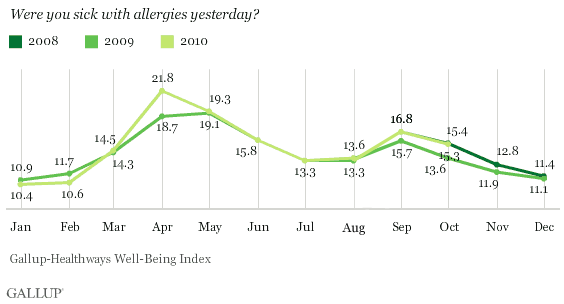
"Were you sick with allergies yesterday?

As reported here in the Los Angeles Times, Gallup released a poll "while you were sleeping" that showed that 85% of Americans were not sick yesterday with allergies. What might make this poll most interesting is "perhaps, because it has nothing to do with politics."

So 15% of you were sick yesterday, and only 17% were sick last September. That's a percentage about the same as the approval numbers for Congress.

Gallup has been keeping track of who is sick with allergies since 2008, and have specifically been asking, "Were you sick with allergies yesterday?"

The report specifically notes that these results are self reported, and not based on medical diagnosis. So the results could actually be higher or lower, or mistaken for cold or flu symptoms.

To learn how to differentiate between cold, flu and allergy symptoms, click here.

Despite my personal opinion I wrote about here, this fall allergy season (2010) compares statistically with 2008, and is slightly worse than 2009 (see graph).

Overall, the report shows that even during the winter months 1 in 10 Americans are sick with allergies. This shows that allergies may have a significant effect on many of our lives, and is an important "diagnosis" to be funded, researched, and hopefully cured.

Yet despite advancements in allergy treatment and wisdom, there still isn't very much that can be done for many allergy sufferers, including myself. The best way to treat allergies is by avoidance of triggers, yet this is easier said than done as I wrote here.

Do you have allergies? How are your allergies this time of year? What time of year are your allergies worse? Discuss.

Thursday, November 18, 2010

Everything you need to know about lung cancer

Today is the Great American Smokeout, so I thought today would be a great day to discuss one disease that might be eradicated some day if we all quit smoking forever.

With pneumonia and COPD being the top two diseases we RTs treat inside the hospital, a close third is lung cancer. So this is yet another good reason to do a quick review of what lung cancer is all about.

Lung cancer is actually the #1 cause of death from cancer, killing as many as 1.4 million people worldwide. And a majority of cases are linked with cigarette smoking. So, like COPD, one could imagine a world with very few cancer cases if nobody smoked.

As you can see by the chaart, lung cancer was basically near zero before the advent of the 20th century, and as the number of people who smoked increased in the 19th century, so to did the rate of lung cancer and lung cancer related morbidity and mortality. It just took lung cancer 10 years to catch up with the rising number of smokers.

Epithelial cells are those cells that line the surface of your body. It lies on top of connective tissue, and many glands are derived from it. It's actually classified as the primary body tissue, with connective tissue, muscle tissue and nervous tissue following.

According to wikipedia, the following are functions of epithelial cells:

  • Secretion
  • Selective absorption
  • Protection
  • Transcllular transport
  • Detection of sensation
  • Specialization (as in the lungs they produce cilia)
Epithelial cells divide, and basically produce clones of themselves. Actually, every seven years your body has produced an effective clone of itself. If an epithelial division produces an error, this is what cancer is.

According to Medical News Today, "Cancer harms the body when damaged cells divide uncontrollably to form lumps or masses of tissue called tumors." Lung cancer interferes with lung function, and can "release secretions that alter body function."

When a cancer displays limited growth and stays in one spot it's considered malignant, yet most cases of lung cancer are considered to be malignant carcinoma's of the lung.

There are two types of lung cancer, and the treatment depends on the type:

1. Small Cell Carcinoma: This is slightly more common in men than women, although it's the least common type of lung cancer. It was formally referred to as oat cell carcinoma.

It responds to radiation and chemotherapy. According to Google Health, this is the fast growing type of cancer and spreads much faster than non small cell carcinoma. It is the aggressive type of lung cancer, and because they spread so quickly, they usually metastasise to other parts of the body before they are diagnosed, including brain, liver and bone. This is why it is usually not treatable with surgery.

Because it spreads so rapidly, prognosis is generally grim, and is likewise associated with smoking.

2. Non Small Cell Carcinoma: Treated with surgery, and can also be treated with chemotherapy and radiation. According to chemo.net, these are diagnosed by default, when all other possibilities have been absorbed, and include about 10-14% of lung cancers. The best way to diagnose is with biopsy. "They grow rapidly, metastasise fast, and are strongly associated with smoking."

Common causes of lung cancer:
  • Cigarette smoke: Cause of 85% of cases
  • Genetic factors: Cause of most childhood cases
  • Radon gas
  • Asbestos
  • Air polution
Lung cancer will show up on an x-ray and CT, and is then confirmed by a bronchoscopy and lung biopsy. Prognosis will depend on how early the cancer is caught and by how much it has metastasised (spread).

It's interesting to note that the five year prognosis of this disease is only 14%, although this does depend upon the stage of treatment.

Symptoms may include (but are generally nonspecific):
  • Bloody sputum (phlegm) (hemoptysis)
  • Chest pain
  • Bone pain
  • Cough (chronic cough
  • Loss of appetite
  • Shortness of breath (Dyspnea)
  • Weight loss
  • Wheezing
  • Facial swelling
  • Fever
  • Hoarseness or changing voice (Dysphonia)
  • Swallowing difficulty (Dysphagia)
  • Weakness
  • Clubbing of the fingernails (not too common) due to chronic hypoxia (low oxygen to the blood)
  • Catexia: Weight loss, fatigue and loss of appetite

It causes shortness of breath because it can block the air passages in your lungs, and leaves an accumulation of secretions behind the blockage, which predisposes these patients to pneumonia. Since lung cancers have fragile surfaces and a "rich" blood supply, they are prone to producing bloody secretions.

Again, the main cause is smoking, since cigarette smoke has about 60 known carcinogens (things that are likely causes cancer), plus nicotine suppresses the immune response to lung cancers. I list all the hazardous chemicals in cigarette smoke in this post.

Along with smoking, women taking hormones are at increased risk for developing lung cancer. Among all males who smokethere is a 17.2% risk of developing lung cancer at some point in their lifetimes, and among women this rate is 11.6%.

Significant to note, among nonsmokers the risk is only 1.4% and 1.3% respectively. So you can now understand the significance of smoking education to children and smoking cessation programs to those who already smoke.

So today is the Great American Smokeout, and a great day to set aside to educate your family members about the dangers of smoking and the importance of quitting for those who do smoke.

Wednesday, November 17, 2010

What it utilization review?

Every hospital has a former nurse who has the position of utilization review. This is the person who's job it is to walk around the hospital, check all the charts, and make sure the patient is sick enough, requires certain services, and is in the hospital the recommended number of days.

According to Kevin Reese, Utilization Review is defined this way:

"Hospital utilization review plans are the documentation that determine how long a patient stays in a hospital for treatment or even if the patient is admitted to a hospital for treatment. It a process aimed at providing quality patient care in a cost-effective manner, reducing hospital admissions and lengths of stay in medical facilities. It compares proposed treatment options to national averages and standards, and is used to determine whether private insurance companies or government-backed Medicaid covers hospital lengths of stay."

Also consider the following:

"Getting patients out of hospitals and into their homes or alternative treatments as quickly as possible is a cost-saving measure aimed at keeping medical costs to a minimum. As soon as a person enters the hospital, a discharge plan is put into effect in hopes of getting the person out of the facility as quickly as possible due to the normally higher medical care costs associated with hospitals. Case managers, hired by insurance companies, are often used to work out discharge plans with hospitals and physicians. Should questions arise about care after a person is discharged, a board of specialists normally will address the case and make a decision on whether care steps taken were appropriate or if the length of stay was appropriate. That decision determines insurance coverage for those procedures."

For further reading click here.

The review process is generally based on Core Measures and Intensity of Service. Core measures is defined this way:
Core measures are the things the medical staff must do when a patient is admitted under a specific core measure set: acute mycardial infarction, heart failure, pneumonia, and surgical care. Within these four sets there are 27 core measures that are based on scientifically-researched standards of care that have been shown to result in improved clinical outcomes for patients.

They have also provided a focus for the development of Clinical Pathways and Standard Orders, both of which assist in the consistent provision of optimal care to patients.

Each individual hospital uses analysis of their own core measures as a means of evaluating performance at their own institution, and as a method of improving this performance.
Intensity of Service basically means that a patient is sick enough to be admitted to the hospital. According to Medicare, Medicaid and HMOs (at least in Michigan), for a patient to meet Intensity of service certain procedures need to be ordered to prove the patient was sick enough to be admitted.

For example, for a patient admitted for pneumonia or bronchitis must have bronchodilators ordered no less than every six hours for at least 24 hours, or any of the following: an IV at greater or equal to 75cc/hour, oxygen equal to greater than 28%, IV/IM intibiotics, or three bronchodilator treatments within the first 24 hours.

So, to make sure Intensity of Service is met, or to make sure the patient meets criteria, and to make sure the hospital is meeting the core values, clinical pathways for each particular diagnoses have been created and are reviewed monthly at our regular Keystone Meetings.

Clinical pathways generally consist of one or a combination of two methods:
  1. Order sets (often called protocols)
  2. Protocols
(Note: I have a post coming soon that describes the different pathways in more detail)

According to this article by Dr. David Schechter at Family Practice Management, while this whole procedure is a hassle, the goal is noble:
  • To make sure the patient really needs to be admitted (see intensity of service)
  • To make sure the patient really needs acute care
  • To make sure the patient "really" needs continued acute care
  • To make sure the patient really needs critical care
  • To make sure the patient the patient is discharged in a timely manner
  • If the patient needs a diagnostic test, can it be done as an outpatient
  • Could the patient's needs be better met another way.
  • Did the patient really need the level of care he received?
  • Could the patient have received a lower level of care?
According to Family Practice Management, "The review process may seem like nothing but a hassle to you, but it’s a necessary evil. Studies have repeatedly shown great variations in care across the country for patients who have a given diagnosis or problem. Furthermore, practicing physicians often simply aren’t aware of the options for lower-level care in their areas."

A good example here is the patient who came to the ER complaining of chest pain and who's cardiac enzymes and EKG came back normal. The patient was admitted with the diagnosis of rule out chest pain and scheduled for a stress test in the morning. Upon review, it was determined the patient could have been discharged and come in for a stress test as an outpatient.

Yet, according to Dr. Schechter, "If the patient had continued to have chest pain or unstable angina, were receiving a nitroglycerin drip or had gotten a positive enzyme test result, then the review decision would have been quite different."

For the doctor, making the right choice may be based on the following:
  • Are the patient’s vital signs stable?
  • Has a diagnosis been made?
  • Has a treatment plan been initiated and modified, if necessary?
  • What acute nursing needs (and other needs) are present? Can these needs be met at a lower level of care?
  • Have you considered alternatives to hospitalization? Why are they not feasible, in your opinion
Options for lower level of care may be:
  • A skilled nursing facility
  • The hospital’s transitional care unit
  • A hospice, for terminal patients
  • A rehabilitation center, for patients needing physical, occupational or speech therapy
  • A convalescent/custodial care center (nursing home)
  • Home nursing visits for help with wound care, IV medications or total parenteral nutrition
  • Outpatient diagnostic testing facilities
  • Outpatient physical, occupational or speech therapy.
Of course, determining this may be the job of the "hospital’s discharge planner."

The Utilization Review Manager will also want to make sure the doctor documents well. For instance, Dr. Schechter notes the following:

  • If patient needs to be in the hospital, the "why" should be in the chart
  • If patient’s status is “observation” or “24-hour stay” rather than “admission,” this should be made clear. It will matter to some insurers.
  • If the patient is unstable, it should be specified how
  • Document the patient’s acute needs (e.g., “unable to stand or walk to the bathroom,” “still febrile,” “vomiting every four hours despite IV Compazine”) rather than simply stating that the patient has acute needs.
  • It should be emphasized in the progress note any abnormal physical exam findings, vital signs or lab values. And make your progress notes legible."
The physician may disagree with the utilization review people from the insurance company, and if this is the case, an appeals process may take place.

Now, CMS expects a doctor will only admit a patient who needs to be admitted, and therefore expects a diagnosis and to be honest. Therefore, they do not allow for a person to review charts and tell a doctor what he should diagnose or order in order to get reimbursement.

For this reason different medical institutions will have unique names for the department and managers in charge of utilization review. For simplicity sakes, we will go by the name Quality Assurance Manager, and refer to this department as Quality Assurance (QA).

Next Wednesday I will expound the the specific jobs of the Quality Assurance Manager, and the ethics involved regarding this position.

Tuesday, November 16, 2010

Allergy meds linked to obesity, heart disease

This new study shows that allergies might be linked with heart disease, the leading cause of death in the United States, and this new study shows that antihistamines used to treat allergy symptoms might be linked with putting on extra pounds.

How's that for a double whammy to start your week. Of course I also have another post,"Does Advair cause weight gain," where I explain the concern that inhaled corticosteroids (such as what is in Advair) may also be linked to putting on extra poundage. Plus we all know by now that a nice big black box warning is on Advair linking it with asthma related deaths.

The thing is, though, that allergies cause such miserable symptoms, we asthmatics often have no choice but to take antihistamines like Claratin. Ironically, just prior to writing this post I woke up with the sniffles and popped a Walatin, a generic form of Clariton. What else was I to do, suffer?

If you've ever suffered from allergy symptoms, you'll know it's nothing you want to just take lying down, and sniffling, and wiping, and perhaps even wheezing. Just that downright miserable feeling -- kind of like a bad cold -- pretty much forces your hand at taking some medicine, if available, to ease the suffering.

Likewise, as with any medicine, you have to weight the advantages with the disadvantages, and in the case of antihistamines it's worth it.

However, it must also be noted that allergies/asthma has also been linked with obesity, as you can read here. And obesity itself increases your risk for heart disease, as we all should know by now.

Likewise, obesity is also linked to worsening asthma, as you can read here. Scientists believe that certain chemicals released from fat tissue may trigger bronchospasm.

Plus those with asthma/ allergies may have a lowered self esteem and not adhere to their medicine regime and not take care of their bodies by eating right and exercising as they should.

Yet this also provides us asthmatics/ allergy sufferers another added incentive to eat right and to exercise. Not only will this help us shed the pounds, it will also make our lungs and even our heart stronger.

Monday, November 15, 2010

Click here if you need an incentive to quit smoking

The November 2010 issue of Parenting Magazine lists "3 New Reasons to Kick Ash." Since November 18 is the annual Great American Smokeout, I thought I'd provide my readers who smoke with an incentive to at least think about smoking. It's also a great day to nudge the smoker you love.

So, the new reasons are:

1. A better mood: Smokers are more likely to be depressed, finds a new study from the Centers for Disease Control and Prevention. Researchers are unclear, though, whether it's the depression that leads to smoking, the puffing that leads to blues, or if both factors could be at play. I wonder if there is a greater likelihood that people who are anxious or depressed in the first place are more likely to smoke in an attempt to allay their anxiety. Just a thought. My wife thinks I'm nuts thinking this, though. What say you?

2.
Clean genes: You know that regular smokers have a higher cancer risk, but a study from the American Journal of Respiratory and Critical Care Medicine found that any amount of smoke exposure causes genetic abnormalities in lung cells, which can lead to a malignancy over time.

3.
No scale shock: Doctors used to warn against trying to diet and quit cigs at the same time, but research from the journal Addiction shows that changing eating and smoking habits simultaneously actually makes women more successful at both. You can maintain your weight post-puffing!

Add these to the following facts:

1. Along with Nicotine, there are 4,800 chemicals in cigarettes that are linked to causing cancer, coronary artery disease, thinning the skin, causing strokes, causing heart attacks, etc.

Some chemicals in cigarettes besides nicotine include:

  • Arsenic
  • Acetic Acid
  • Acitone
  • Ammonia
  • Benzene
  • Butane
  • Cadmium
  • Carbon Monoxide
  • Ethanol
  • Formaldehyde
  • Hydrazine
  • Hexamine
  • Hydrogen Cyanide
  • Lead
  • Methane
  • Methanol
  • Naphthalene
  • Nickel
  • Phenol
  • Polonium
  • Steric Acid
  • Styrene
  • Tar
  • Toluene
2. Consider the following facts about quitting smoking:
  • Within hours after you stop your carbon monoxide level falls to normal and the oxygen in your blood increases
  • One day after you stop your risk for heart attack starts to go down
  • Two days after you stop your nerve endings start to repair themselves so your senses of taste and smell start to return to normal
  • Two weeks after you quit your lungs are working 30% better than before you quit
  • Within 1-9 months lung function continues to improve, cough, sinus congestion, fatigue and shortness of breath all decrease as your lungs regain normal function
  • Within one year your risk of heart disease is cut in half.
  • Within 15 years risk of stroke, lung cancer and heart disease are that of a person who never smoked, and you can consider yourself fully healed..
3. There are many more reasons you should quit smoking. Consider the following links for more ideas.

Related links:

Sunday, November 14, 2010

Compassionate and nice people are loved

Every person has a natural yearning or inclination to be liked. And one of the keys to like-ability is compassion. If you are a nice person, this will make up for many of your flaws.

I find this to be true of many people. We have one doctor who works in our emergency room who is the slowest doctor on the planet, and many of the ER nurses can't stand working with him because he is so slow. Yet he is so nice to me I love the man. I look forward to when he is working. He is compassionate, and therefore I like him.

I also find that people with political affiliations I do not agree with are my friends. The reason is that they are awesome and empathetic people. When you care for my feelings, when you are compassionate, I will like you.

I'm sorry, but that's just the way I am. In my book, compassion gains a lot of weight. In the area of like-ability, if you are compassionate to my feelings, if you put me before you, then I like you. That's how I define compassion: you put yourself second. You are humble.

If you are humble, the chances are you will be compassionate. If you put other people before yourself, if you are not arrogant, if you do not judge others, then chances are you are compassionate. Then the chances are I will like you on that ground alone.

Heck, you could be the worse doctor in the world. Yet if you are compassionate, empathetic, and nice, you will be loved. I find this to be true in many cases. And the Trauma Junkie wrote a neat post about compassion here.

Compassion basically means that you are treated as a person. Or, as dictionary.com notes, compassion is "a feeling of deep sympathy and sorrow for another who is stricken by misfortune, accompanied by a strong desire to alleviate the suffering."

In essence, compassion is empathy.

As the Trauma Junkie notes (check out his blog here):
Compassion is your best weapon to treat your patients, and is often your last resort. But it should always be your first.

Compassion is greater than any drug or therapy. It has the power to mend hearts and give hope. And the best thing about it? Compassion inspires compassion. It's a vicious circle, and a vicious cycle. Do you set the example?

I don't know how many of you have ever heard the old adage, "A little oxygen, a warm blanket and a few kind words can go a long way." This couldn't be any more true.

I can't count the number of lives I've saved using invasive procedures or complex therapies. I have no tally for the number of patients I've seen die, or the number that have lived. But I can count the number of times my company has helped better a patient (or family member's) day, because I use it with every patient.

Compassion is funny. Sometimes you see the results, and sometimes you don't. Like all therapies, not all patients are accepting of it. Sometimes, compassion doesn't work. But more often than not, it does.

And the good thing about compassion is that you can pay it forward. Doing a simple favor such as refilling your patient's water pitcher or holding their hand, can come back to you ten-fold in the future. You do a good deed, and you get one in return.

Every day, new therapies and new medications are developed. Advances in treatment are made. But the one thing that has been around since the beginning is sure to work in your favor. Remember that.

Technology is great, but in the mix of numbers and values, we often forget that we are treating a person. A human being like you and I. Treat the patient, not the numbers.

I promise you that if you try it today, you will be a better provider. So what are you waiting for?
So what are you waiting for? Be compassionate? For crying out loud, you are in the medical field. Sure we need people of all personalities, but for the love of God, show some compassion today. Show some empathy.

Love.

Saturday, November 13, 2010

It's doctor to you

Whenever we approach someone of a higher rank it is appropriate, compassionate, to provide the proper salutation. In the case of us RTs and RNs, we refer to doctors as doctors. That's doctor Smith to you.

I write this because I have a couple friends of mine, people who used to be fellow RTs and RNs, who are now doctors. At first I wondered how I should greet them. Then I decided that they worked hard to earn the title of doctor, and they should get due respect.

Just by calling a doctor a doctor does not mean they are above you in any regard. They are fellow men, they are unprofitable servants of God just as you and I are, seeking to make the world a better place by the time they leave this world.

I have only one time in my career as an RT, in my 15 years working with doctors, had a doctor tell me to call him by his first name, and that was the only doctor I ever called by his first name. Other than that, the compassionate thing to do is for all of us to give due respect, and call Dr. Smith a doctor and not Sam.

Friday, November 12, 2010

Compassion makes up for many flaws

I pray every day before I go to work that I do not join the complainers, that I will not write or say anything that can be used against me, and that I will do the best by myself and my patients. I pray that I'm compassionate, and others are compassionate to me. Help me to have discretion.

Yet, admittedly, there are days I have to bite my tongue. These are the days of which the Lord challenges me. Last Tuesday was one such day at work, and today was one such day in the blogosphere.

On Tuesday I worked amid the chronic complainers, and it was a challenge to remain above them, to keep my mouth shut and ears closed. Likewise, I was swamped, and a fellow co-worker was unwilling to be compassionate toward me. Yet I trudged forward and did all the work myself, and I did it with a smile.

We RTs are capable of accomplishing a lot in a short amount of time. Yet there are times we need help. There are times, for whatever reason, we become overwhelmed with procedures and need a helping hand. Usually we handle it on our own, yet at times we seek help.

While we RTs work well together as a team, occasionally one of us is not compassionate. The following are not good excuses to not be compassionate toward a co-worker
  1. I'm talking on the phone, yet I say, "I'm sorry, but I have treatments do
  2. I'm selling Avon to a co-worker, yet I say, "I'm sorry, but I have treatments do
  3. I waited to the end of my shift to chart, and I say, "I'm sorry, but I have charting to do
  4. I'm burned out. I can't help

Compassion is going the extra distance to help a coworker. Yet compassion is also knowing when there is not help, and trudging forward and with a smile, making the best of it.

This morning I was contacted by a lawyer to remove a post because he claimed I violated copy write laws. I did not violate any laws, as I provided only a snippet of what was in the book, and also provided proper attribution.

Yet as a compassionate person, I deleted the post. I did not take this action because I was wrong, but because it's not worth the battle. Or, as the old idiom states: Discretion is the better part of valor.

Or, as the proverb goes, " It is good to be brave, but it is also good to be careful.; If you are careful, you will not get into situations that require you to be brave.

Thus, even if you know you are right, sometimes it's best just to walk away, to delete the post, or to keep your mouth shut. In this way, you take the high road, which, according to American Heritage Dictionary, Fourth Edition: "The most positive, diplomatic, or ethical course."

Still, it's not always easy taking the high road. It's not always easy being compassionate, especially when outside the patent's room you are feeling overwhelmed. It's hard to turn off your gloomy mood as soon as you walk in to the patent's room.

Therefore, it's better to never let yourself get gloomy. It's best not to let people or situations beyond your control drag you down. It's better to stay on the high road.

It's better to have faith and hope. It's better to be optimistic. It's better to smile. It's better all the way around. It's better to pray.

To help keep myself on this higher ground despite procedures I disagree with and obstacles in the way of my ability to communicate, I am going to write only about uplifting and compassionate things on my blog this weekend.

Hence, the Frea Wit and Wisdom of the week: "Compassion makes up for many flaws."

Thursday, November 11, 2010

Core Measures

As a medical care professional, whether you're a respiratory therapist or a registered nurse, it's important you understand the behind the scenes politics. Sure you may wonder why you're doing breathing treatments on someone who doesn't need them, yet believe it or not, there is a good method to the madness -- most of the time.

Or if it's not a good method, at least it's a method nonetheless.

Whether or not you think government involvement in the health care system is a good or bad thing, the Centers for Medicare/Medicaid Services (CMS) established what they call "core measures" as a means of improving quality of hospital care and reducing costs. While I don't care for government involvement, I think the idea of "core measures" is a good thing.

Yes, it may result in some overkill, yet sometimes some overkill is needed to meet the ultimate goals of an institution and the overall health care system to the benefit of the patient and to assure cost effectiveness. Bare with me, because by the time this post is complete hopefully you'll have a better overall understanding of what I mean.

So, what are core measures? Please forgive me if I don't get this exactly straight, because I'm learning along with you. Yet after participating in a year's worth of administrative meetings, given presentations, interviewed coworkers and completed a ton of research where I think I have enough information to write about this nearly inexplicable subject.

Core measures are the things the medical staff must do when a patient is admitted under a specific core measure set: acute mycardial infarction, heart failure, pneumonia, and surgical care. Within these four sets there are 27 core measures that are based on scientifically-researched standards of care that have been shown to result in improved clinical outcomes for patients.

Basically, for each particular diagnosis, or diagnosis related group (DRG), the core values are all the things that the latest wisdom has proven work to increase recovery time for that patient.

They have also provided a focus for the development of Clinical Pathways and Standard Orders (post on this coming soon too), both of which assist in the consistent provision of optimal care to patients.

By Clinical Pathways we mean the creation of a system throughout the hospital that makes sure what needs to be ordered is getting ordered, and then completed. One example of this is our hospital has created order sets and protocols for several DRGs.

Now I am of the impression that order sets are bad and protocols are good. This is a topic I will discuss in more detail in an up and coming post.

These order sets and protocols act as a hymn book to make sure every professional taking care of the patient, from the doctor to RT, from the nurse to the lab techs to the x-ray tech, know exactly what their roll is for the patient.

A protocol is a standard order approved by the medical staff that gives the nurses and respiratory therapists the opportunity to do what is best for the patient given the circumstances. If used properly, these work to the benefit of the patient (improved care when needed), the staff members involved (improved morale) and the physician (decreased irritating calls).

An order set is a sheet of paper that the nurse pulls from a cabinet as soon as a patient is, for example, diagnosed with pneumonia. The set is a list of all possible options for that diagnosis. Some of the options that are most essential, such as making sure a sputum is ordered and obtained before the initial antibiotic is given, and giving that first antibiotic within six hours from the time the patient hits the door, are automatically ordered.

Many hospitals are incorporating order sets that automatically set in motion certain things that assure core measures are met, because these are scientifically proven to speed recovery and reduce costs. Examples are x-ray on admission and each morning for the next three days, labs on admission and each morning for the next three days, oxygen, IV, etc. These things must be done on all pneumonia patients, and the order set sets this in motion.

Another thing that is automatic is antibiotic selection, although the doctor will have options here. The emergency room nurses have a process in place where they will make sure the patient gets the antibiotic within six hours if the patient is still in the emergency room, and then there is another system in place to make sure this antibiotic is given within six hours if the patient is admitted to the patient floors.

When x-rays and labs are ordered, they pop up on a tracker board automatically through a computerized system both on a board in the emergency room and on similar tracker boards in the lab and x-ray departments. As time elapses, the color of each particular procedure changes from green (you have some time) to red, which means it needs to be done soon or right now or STAT or at least given top priority.

At Shoreline we have a bright orange laminated sheet that is inserted into the patient's chart right before the doctor's orders section, so that every person who looks at the orders is reminded of the importance of core measures.

Sure order sets might result in some overkill, yet all these reminders, all this motion, makes sure the hospital is meeting core measures for this patient. It also assures the hospital is meeting Intensity of Service. For example, on our order set, the options of IV, antibiotic selection, and breathing treatments are on the order set.

Used appropriately, one can see how order sets and protocols, when used together, can result in improved outcomes and reduced costs, improved staff morale, and decreased annoying calls to the physician.

Each individual hospital uses analysis of their own core measures as a means of evaluating performance at their own institution, and as a method of improving this performance.

Here at Shoreline Medical we analyze core measures data at our weekly keystone meetings. An example of the data we look at can be seen in the picture to the right.

The goal is to obtain a 90% rating in each core measure, as indicated by green. If the rating is less than 90%, this would be indicated as red.

The results are reported to the Joint Commission, which records this data on their website so anyone can see where each hospital stands in each area.

The Health and Human Services (HHS) has created a new website so you can check out hospital core measures. The site created is the Agency for Health Research & Quality (ahrq.gov). Another site is HHS's new site hospitalcompare.hhs.gov.

However, as I noted in this Keystone post, "It must be noted, however, that these measures must not be used as a report card to compare hospitals, rather as a tool for hospital improvement. What I mean by this is that if you consider 80-90% a B grade, and 90% or greater an A, you might actually be mislead.

"If you have a small hospital that has only admitted 10 patients with an MI over a span of a month, and a larger hospital has admitted over 100 such patients, and both hospitals forget to
properly chart two patients for whatever reason, the small hospital's stats will show 80% (a B grade) and the larger hospital will show 98% (an A grade). Yet both hospitals made the same amount of errors.

"So, again, these core measures and the percentages that go with them should not be used as a report card to compare hospitals, but as data to assist improvement."

At Shoreline, and other hospitals in Michigan, we get together in a monthly Keystone Meeting to discuss the recent core measures data, and then try to implement a systematic approach to improving our data. For example, back in 2007 there were many core measures where we were in the red, or less than 90%. Our current statistics are mostly green.

Thus, based on these core measures, we have created a a rapid response team, a sepsis protocol, an extubation protocol, a ventilator bundle, a sepsis bundle, a pneumonia bundle, an MI bundle, a heart failure bundle, a surgical bundle, among other successes that have reduced the number of patients being transported to the critical care, and obtaining nosocomial infections. This also includes a reduction in cases ventilator acquired pneumonia (VAP, other nosocomial pneumonia, and sepsis, and has likewise reduced readmission rates (post on this coming Sunday).

We have also created an array of order sets for pneumonia, CHF, sepsis, COPD, asthma, ventilator, ventilator extubation, etc.

So you can see these core measures are a good thing. The only problem I see is our hospital has incorporated all these order sets and no protocols to go with them (with the exception of the ventilator extubation protocol).

This ultimately results in a lot of overkill. For example, every sepsis patient gets ABGs, every pneumonia patient gets breathing treatments, and most patients get EKGs. While these procedures are needed for some patients admitted with said disease, they are not needed for all. Likewise, once breathing treatments are ordered, they are never discharged.

The result here is RT and RN burnout trying to get all these things done just so the hospital meets core measures, and the hospital gets reimbursed. It wrongly gives the hospital the impression of caring more for money than for patients.

The ultimate goal, however, I believe, for the government in all of this, is to use these core measures as a means of reimbursing hospitals based on performance rather than for each procedure provided to the patient. Now I'm not sure this is a good thing or not, yet that's the ultimate goal.

Actually, the ultimate goal for the government in all this is to reduce costs, so that when the new health care reform goes into effect, and if the United States eventually adapts a Federalized Healthcare Program such as exists in Britain or Canada, the cost to the government will be minimal.

So, what are the specific core measures? Here are the core measures that are being monitored today:

1. Acute Mycardial Infarction:
  • Aspirin at arrival
  • Aspirin prescribed at discharge
  • Angiotensin converting enzyme (ACE) inhibitor or angiotensin receptor blocker (ARB) for left ventricular systolic dysfunction (LVSD)
  • Smoking cessation advice/counseling
  • Beta blocker prescribed at discharge
  • Time to percutaneous transluminal coronary angioplasty (PTCA)
  • Inpatient mortality
2. Heart Failure:
  • Aspirin at arrival
  • Aspirin prescribed at discharge
  • Angiotensin converting enzyme (ACE) inhibitor or angiotensin receptor blocker (ARB) for left ventricular systolic dysfunction (LVSD)
  • Smoking cessation advice/counseling
  • Beta blocker prescribed at discharge
  • Time to percutaneous transluminal coronary angioplasty (PTCA)
  • Inpatient mortality
Community Acquired Pneumonia:
  • Oxygen assessment within 24 hours of arrival
  • Pneumococcal and influenza screening and/or vaccination
  • Blood cultures prior to first antibiotic dose
  • Smoking cessation advice/counseling
  • Arrival time to first antibiotic
Surgical care improvement project: (check out this link)
  • Providing a prophylactic antibiotic within 1 hour prior to surgical incision
  • Providing a prophylactic antibiotic selection for surgical patients consistent with each type of surgical procedure
  • Discontinuing the prophylactic antibiotic within 24 hours after the end of surgery because prolonged use of antibiotics increases the risk of Clostridium difficile infection -- a bacterium that causes diarrhea and more serious intestinal conditions such as colitis -- and the development of pathogens -microorganisms such as bacteria, viruses or parasites that can cause disease -- resistant to antibiotics
  • Controlling postoperative serum glucose in cardiac surgery patients because high blood sugar weakens the immune system and increases the risk of infection
  • Clipping the hair of surgery patients rather than shaving because skin abrasions increase the risk of infection
  • Maintaining immediate postoperative normothermia (normal temperature) in colorectal surgery patients because increased temperatures pose a greater risk of infection, prolonged healing of wounds and longer hospital stays.
Based on these core measures, a major initiative of the Keystone Project was to improve outcomes of the critical care. It is actually the largest statewide collaborative ever: 76 hospitals, and 120 intensive care units. By this accomplishment it has also reduced costs for both the hospital and the government.

Interventions of the project include:
  • Implement a unit based safety program
  • Eliminate central line associated blood stream infections
  • Eliminate Ventilator associated pneumonia (VAP
  • Implement daily goal sheets
  • Implement sepsis bundles to reduce ICU mortality from severe sepsis and septic shock
So you can see that the overall idea of core values is a good thing to improve quality of patient care and reduce costs -- if done the right way. It's also a method Medicare uses to pay hospitals, and a means of making sure doctors, nurses, RTs, x-ray techs, lab techs, and administrators are on the same page (all singing from the same hymn book) when it comes to taking care of the patient.

Again, though, the bottom line as far as a specific institution is concerned is to make sure we are doing all we need to do to ensure that we will be reimbursed. We have set up order sets so that everything that the most recent evidence shows will benefit those patients is ordered.

The pneumonia order set has bronchodilators every 6 hours. This assures that a bronchodilator is ordered by the attending physician. Now we know full well that pneumonia does not cause bronchoconstriction, yet by ordering bronchodilator treatments the physician is making certain the hospitals foremost experts on the lungs are assessing the patient every six hours during the course of the day."

Reminders are in the charts for us RTs too. Since best practice evidence shows a speedy extubation reduces ventilator acquired pneunonia, our extubation protocol encourages us to think extubation as soon as the patient is intubated. So we have laminated sheets in the chart to remind everyone who cares for the patient what this protocol is. Another laminated sheet on the chart shows a simple step-by-step algorithm to extubation.

Reminders are everywhere. Some are laminated sheets, some are signs on bulleton boards, some are on the tracker board, some are sheets of paper that print of in respective departments. Likewise, our department supervisors double check our charting to assure we are properly charting. It's the job of your boss to make sure everything is charted properly so core measures and Intensity of Service is met.

Yes, you might think your boss is hounding you at times. You may get lots of notes. Yet this is the job of your boss. His job is to make sure you are doing everything for that patient based on core measures. If core measures are not met, the hospital may not be reimbursed. So if you get the feeling your boss is paying too much attention to your charting and not enough attention to the patient, now you know that's not actually the case.

Yes, there is some overkill. Yes, there will be some needless procedures (such as bronchodilators on all pneumonia patients), yet the ultimate goal is to improve quality and reduce costs (which is the bottom line).

The neat thing about the monthly keystone meetings at Shoreline is that any time any person who cares for the patient has an idea to improve the process, or if new wisdom is learned, this gets reviewed and better clinical pathways are created.

If you're still confused about core measures, don't worry because so are the same people responsible for monitoring them.
Add to Technorati Favorites